

lunchtime colloquia 2025-2026
Lunchtime Colloquia 2025-2026
AWRN Virtual Colloquium With Dr. Anne Eller
April 30th, 2026
Introduction by Dr. Christopher Hodgkins
Dr. Anne Eller from Yale University
Present: Dr. Christopher Hodgkins, Dr. Anne Eller, Dr. Ana Hontanilla, Dr. Veronica Grossi
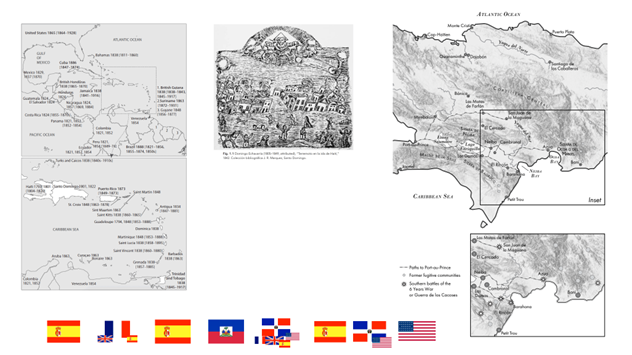
- “The men with pens” control the historical accounts of the city of Santa Domingo, the only ones able to tell the history of this region
- The capital is on the northern Atlantic coast; this is where the history writing is happening
- It is also the site of where people experienced slavery the most directly
- Their history is overwritten in the 1800s with “the men with the pens”
- Dr. Eller is working on research of an 1890s rebellion in the borderlands
- Eller rejects the Dominican Fiction, the rewritten history of plantation slavery. Instead, she strives to write the story of indigenous people
- 1893 rebellion: Biembines. As there is no newspaper in the area, Eller has very little contemporary information about this uprising
- She is particularly interested in the borderlands space
- Why does the founding generation in the 1500s, with these packs of alliances, continue to have such ideological importance in the borderlands? This can be seen in the vocabulary for the revolt
- Eller’s research includes borrowing languages from different places and people
- Michael Amoruso is an anthropologist who looks at Catholicism in Brazil, people who are praising the “indefinite suffering dead,” claiming that the historian almost needs to speak to the people who are killed as each group of people arrive
- Eller is looking for a lexicon of remembrance in this place through the lens of this revolt
- It’s important to consider the vocabulary of how people identified themselves in Santa Domingo during different colonial changes of power
- Sparse evidence here gestures to the complexity of southern communities
- Nothing disorderly to see, blond officers, neighborhoods away from people identified by class, family name, education, church attendance and other factors
- The strategic positioning of upper classness or whiteness
- Eller considers where these anecdotes are coming from? Are these people interacting with working class people or rather communicating exclusively with townspeople?
- In the Borderlands, you must tell other people about your reputation
- Men and some women in the region are bragging that bullets can’t kill them, a form of cultural heroism that derives from the African diaspora
- “The state” amounts to several generals, and acts of violence give these generals legitimacy
- Eller claims that when we see how the powers are operating, we really see the grammars that come from enslavement
- A place surrounded by slavery, and the subject is on everybody’s tongues except for the “men with pens”
DISCUSSION SECTION:
- Having to interact with sources that have not been written
- It’s difficult to try and understand their identity, worlds of power and violence, rhetoric of war, sexual violence, central to how the self is identified
- What is the blurring of gender self-identification and naming?
- Gender inversion is deep in the Congo lexicon, where a healer is particularly powerful and can switch genders, looking at the plural naming
- US officials come to West coast of Hispaniola, did not speak to enough people, and did not speak to people in the Borderlands
- Eller looked back at documentation of Dominican Civil War, people’s houses burning, government is low budget, the rebellion is low budget, people are using acts of terror to get what they want
- Novels written in the capital that portray local women in horrific ways
- Men struggle to find work in the surrounding ecology (semi-arid and unpredictable); developing other cattle-grazing spaces from the 1800s
- How do we use contexts of other rebellions to understand this one?
- For instance, knowledge of the Brazilian backlands helps one to understand Dominican literary perspectives and amplifies the text
- Also, Brazil has good records compared to Santo Domingo, which can help contextualize how men organize power in rural cattle regions
- Women travelling constantly in Hispaniola; they get to Port-au-Prince in Haiti by lowland travel, grabbing newspapers from Port-au-Prince and bringing them back to their villages
- Thus they are informed by the Haitian Revolution, which was informed by French Enlightenment ideals
- Many scholars of Caribbean Studies have focused on Cuba
- Santo Domingo’s “men with pens” are horrified by the Haitian Revolution
- “Men with pens” often but not always are “white-presenting” individuals, using photos of peasants as propaganda; people willing to lie about their identities
- There is a distinct mountain culture of those isolated lofty places well protected from invasion, with “mountaineers” developing an independent identity
- How are they imagining their own nationalities?
- Historical scholars increasing are looking to literature and imaginative fiction to help with actual research that has not been completed
- Plantation settings use paranoia as a weapon
- Difficult to research fuzzy and multinational contexts, because of blurry borders in a borderland region
Connect with the Glocal: A Research Initiative on Transnational First-Generation Student Pathways to College Readiness
Presented by Dr. Jeremy Rinker, Peace and Conflict Studies
Dr. Ana Hontanilla, Languages, Literature, and Cultures
April 14th 11:45 AM – 1:30 PM
Present:
Dr. Aaron Allen, Musicology, Director of Environment and Sustainability
Dr. Maria Anastasiou, Global Engagement Office
Dr. Christopher Hodgkins, English
Dr. Ana Hontanilla, Languages, Literature, and Cultures
Dr. Magana Kabugi, English
Dr. Carl Mattacola, Health and Human Sciences
Dr. Christian Moraru, English
Dr. Sherine Obare, Research and Engagement
Dr. Jeremy Rinker, Peace and Conflict Studies
Louise Scoville, Atlantic World Research Network Graduate Assistant
Dr. Selima Sultana, Geography, Environment, and Sustainability
______________________________________________________________________________
Connect with the Glocal: A Research Initiative on Transnational First-Generation Student Pathways to College Readiness
Project Purpose: Investigate how First-Gen students at UNCG understand the relationship between global issues and local realities without studying abroad, with particular attention to transnational positionality, cultural capital, and pathways to college and career readiness.
Current Challenges with Project:
- First Generation UNCG students are underrepresented in exposure of study abroad programming
- Definitions of “global” remain abstract and ill-defined, insufficiently connected to lived experience
- UNCG students have gaps between global knowledge and local impact
- Existing models of global learning often overlook multilingual and multicultural lived realities already present on campus.
Project Approach:
- Reframe “global” as as lived and grounded in local experience beginning at home.
- Connect lessons to Greensboro lived experiences and community contexts.
- Make learning in the classroom more equitable and relevant by positioning the classroom as a site of transnational knowledge production.
- Framing learning as globalization. This begins with the interpretation of the global and the local, resulting in unique outcomes in different geographical areas, recognizing students’ existing global awareness.
Methodological Framework:
- The project would incorporate a structured research component led by undergraduate student researchers.
- Students will conduct interviews, questionnaires, and community-based observations focused on first-generation and transnational experiences.
- Monthly collaborative sessions will support the co-development of research instruments, data analysis, and iterative inquiry.
- The project will document how students mobilize cultural, linguistic, and transnational capital in navigating higher education.
Project Background/ UNCG Student First Approach:
- Many students speak another language besides English at home.
- Education Levels of Multilingual and Multicultural Households in Guilford County:
- Professionals, Well-Educated, often working in local jobs below their levels of education in their countries of origin, are heavily invested in their children going to school and receiving education in Greensboro. These households demonstrate strong investment in education and upward mobility.
- Optimism in students coming to UNCG.
- Announced Project Proposal for the Ignite Grant
Discussion Questions for the Group
- Where does global knowledge come from?
- How can communities become spaces for developing global understanding?
- What forms of cultural knowledge that multilingual students use to navigate higher ed?
- How can universities transform global learning into an inclusive experience accessible to all students?
- What type of local engagement will help students develop their critical thinking and intercultural awareness?
- Connect with the Glocal
- Global Knowledge, is understood as relational, lived, and embedded in everyday experience rather than distant or abstract
- College belonging: The project emphasizes transnational positionality and local-global entanglement.
- Future pathways
- Cultural Strengths, Global awareness is recognized as already present in students’ lived realities, particularly among multilingual and multicultural populations
- First-Gen student pathways
Expected Outcomes:
- A research-based curriculum toolkit integrating glocal/transnational perspectives.
- A report synthesizing findings on first-generation transnational student experiences at UNCG.
- Identification of best practices for inclusive global learning beyond study abroad models.
- Preparation of materials for external funding and scholarly publication.
Feedback and Discussion:
- Culture as Crossroads
- Inclusive but not Intrusive programming in the classroom.
- Group work in the classroom to bring in new perspectives, how to build and assign groups.
- International and cross-cultural students in the classroom as educational resources.
- Study Abroad Learning and programming.
- Place as a jumping off point for discussions in the classroom. What does “place” mean to you?
- Rural vs. Urban
- Coming to the city (Greensboro) from the rural
- How do students define their own setting and place
- Student comfort and exploration
- Learning vs. tourism
- How do we increase curiosity from local students?
- Food and food traditions as a tool of learning, a vehicle of trust and interest.
- Where are our students growing up?
- UNCG students are highly aware of where they are coming from.
- Students don’t want to ask questions or be invasive.
- Asking students to identify what they are experiencing in their place or community.
- How to facilitate dialogue between students who have different experiences of place.
- Global does not erase the Local.
- Global courses refigured with the inclusion of international students.
- The proposal of a first-year experience seminar instilling glocal values.
- Teaching students how to travel and dissolve international binaries.
Worlds Ahead, Worlds Behind: Recalling and Reinventing Norway, Albania, and Ukraine from American Shores
Worlds Ahead, Worlds Behind Symposium Materials
Wednesday, September 17, 2025